
PICUS

From the Restorer's Knuckles to Artificial Intelligence: The PICUS System for Diagnosing Detachments in Cultural Heritage
A wall painting, a mosaic or any architectural covering is the outermost layer of a stratified system. When the layers separate, the surface comes to rest on a cushion of air, and it answers a tap with an unmistakable hollow sound. For centuries the most reliable way to find these voids has been exactly that: a conservator taps the surface with the knuckles of one hand, feels the vibration with the palm of the other, and marks on a drawing what the ear has judged.
The method is accurate and it is genuinely non-destructive, but it carries a strong subjective imprint, which makes it non-repeatable. Two specialists may hear the same wall differently; the transcription of what was heard onto a map is a further interpretive step; and on large surfaces the task is physically demanding. The laboratory alternatives — laser Doppler vibrometry, speckle interferometry, infrared thermography — are precise but hardly executable on site, since they need optimal operating conditions, post-processing, and costly technical consultations.
Since 2018 a research line carried out at Roma Tre University, with the Università della Tuscia and CNR, has worked on a third way: an instrument that reproduces the restorer's gesture with a calibrated, repeatable force, records the answer of the surface, and turns a sequence of taps into a map. The instrument is called PICUS, from the Latin word for woodpecker. What follows is the story of how it was built, year by year.
2019–2020: Modelling the sound of a void
The first published step was theoretical. A detachment can be described as a circular plate with clamped edges, of radius a and thickness dm, vibrating over a cylindrical air cavity. The equation of motion for symmetric harmonic vibrations yields the plate displacement in terms of Bessel functions, and introduces the "kettledrum parameter" that accounts for the compression of the air trapped in the cavity. From this the mechanical impedance of the plate follows, and with it a quantity that can be compared directly against measurement.
The distinction that matters for diagnosis comes from the modal analysis: vacuum-type modes radiate their energy away quickly, while in cavity-type modes the motion stays trapped in the cavity and decays slowly. This is precisely what the restorer's ear registers as a hollow sound, and what an oscillogram shows as a longer decay time.
The model was validated on a PMMA test object with a cylindrical cavity of 50 mm radius and 40 mm height, closed by a 2.2 mm plate, measured with a laser Doppler vibrometer and a condenser microphone while a loudspeaker swept the 50–5000 Hz range. The measured natural frequencies of the plate on the cavity agreed with those predicted by the theory. Mapped over the surface, the mechanical impedance and the resonance frequency both drew the central detachment clearly.
In parallel, the first probe was built: an electromechanical percussion element housed in a Teflon cylinder interlocked by three springs, so that it follows the roughness of the surface without ever changing the impact distance. The knocker is a tubular push solenoid; a custom return spring speeds its recovery, and the control signal sets the impact force anywhere between a nominal 30 N and the 0.4 N actually used. One second of monophonic audio per point was recorded at 48 kHz and 16 bit, transformed into a narrow-band spectrogram, and compared with the spectrogram of a reference point chosen by the conservator through spatial cross-correlation. The resulting similarity index, plotted against the topographic coordinates of each tap, produces what the authors call the acoustic signature of the surface: the status quo of the covering at the moment of the analysis, and therefore something that can be measured again later and compared.


The physical basis of the method: the sound of a detached area decays far more slowly than that of an adherent one.
2021: A pocket-sized instrument
Two contributions published in 2021 turned the laboratory method into a device. The first explored an ergonomic, battery-powered unit shaped like a computer mouse, built around an economical 32-bit Arduino-like board, and based on a complementary measurement: the impact time. A defect reduces the local stiffness of the structure, which widens the force-time pulse recorded by a force sensor in the head of the solenoid shaft. Sampled at over 500 kHz, that pulse width becomes a second, independent indicator of the bonding state — one that works on glazed ceramic tiles, where delamination of the glaze is a severe and very shallow conservation problem.
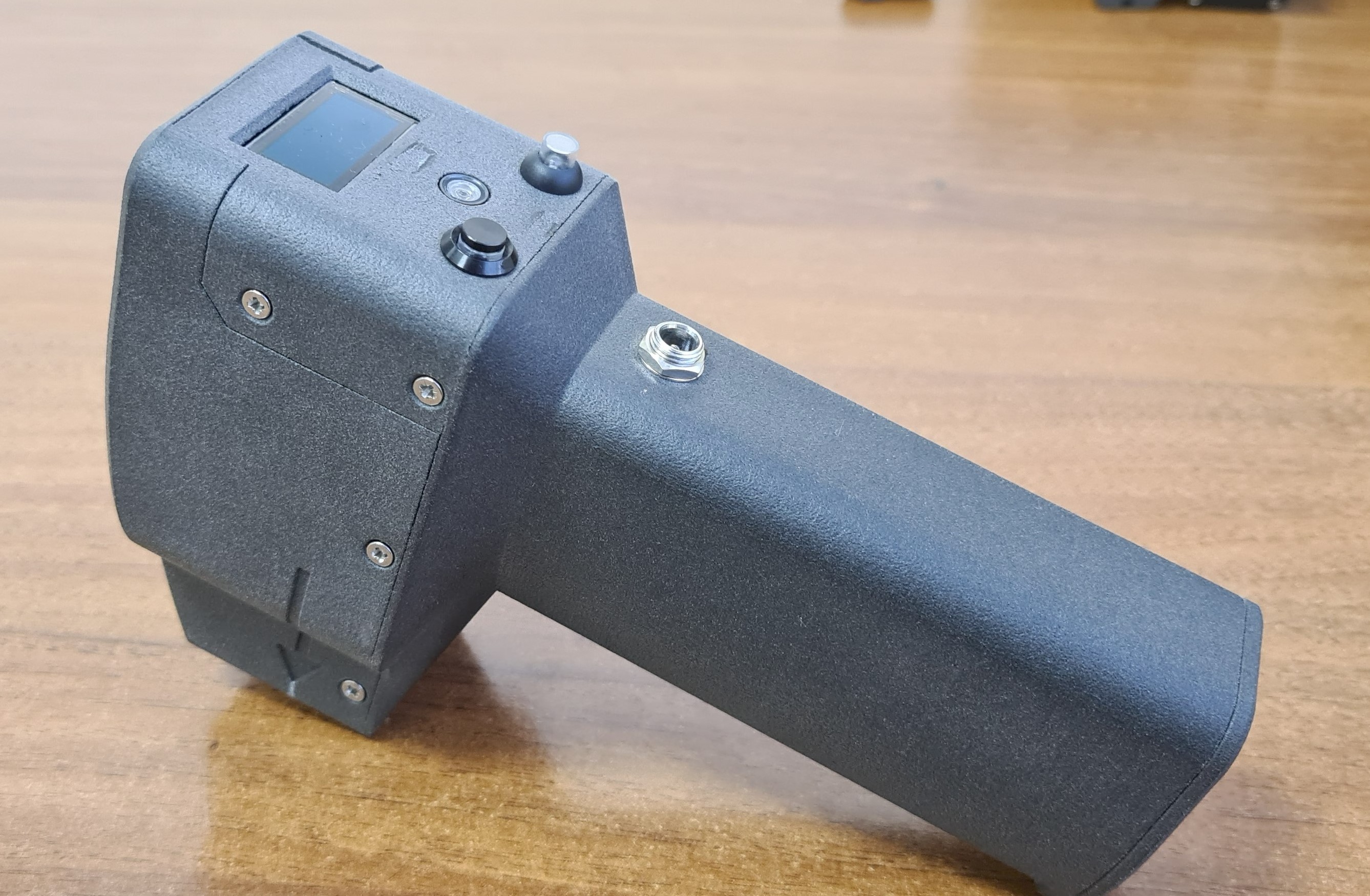
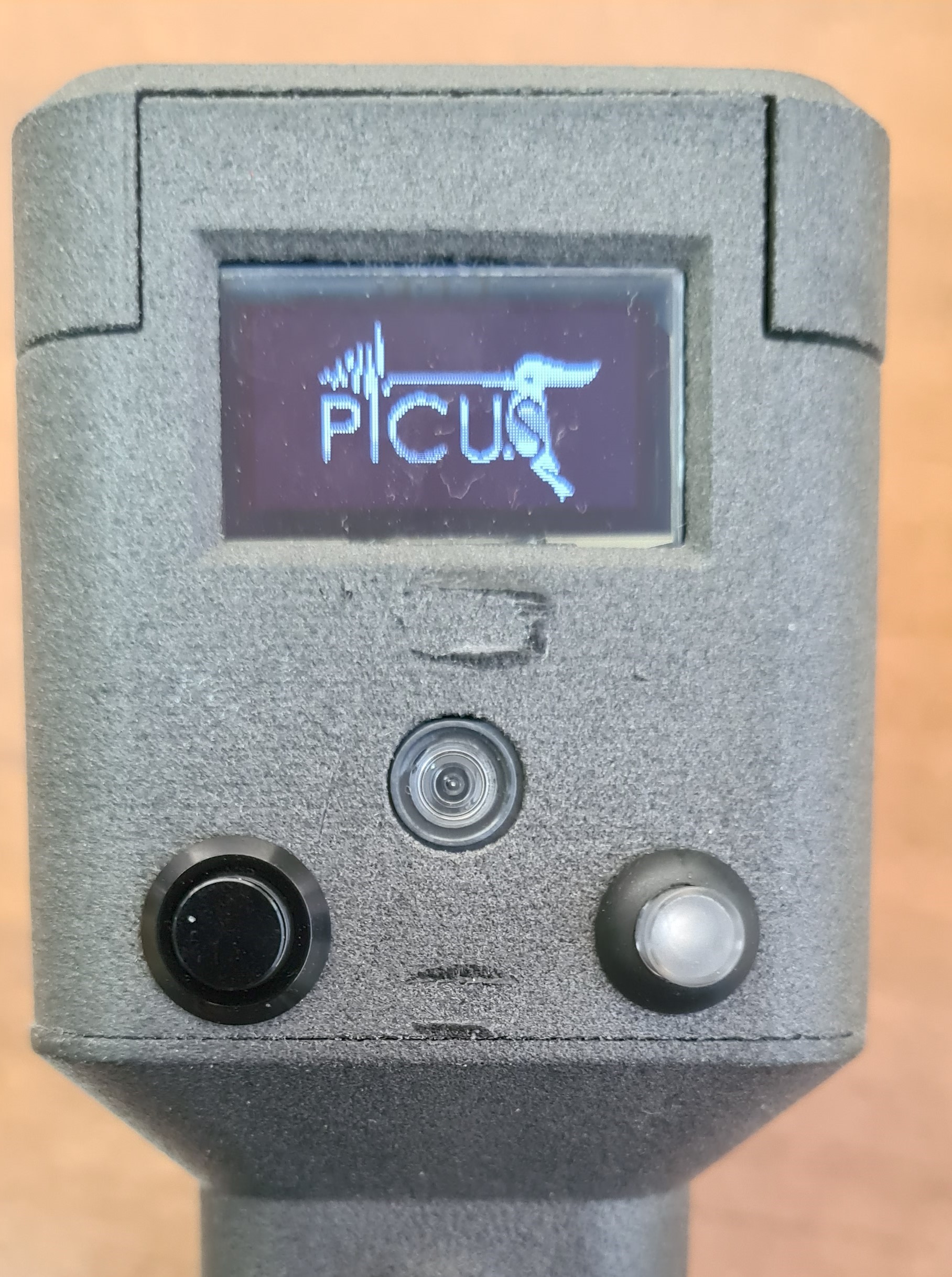
The second paper presented PICUS proper. The system fuses three elements in a handheld tester:
- A percussion unit built on a low-cost 5 V solenoid mounted on a mechanical slide, so the impact force can be calibrated once for the material at hand; after calibration the force no longer depends on the operator, who only chooses where to place the probe.
- A force sensor made in the laboratory from two prestressed PZT ceramic rings in a metal case, giving impact forces of roughly 0.3–2 N. It also triggers the acquisition window for the microphone.
- An IR positioning system: a very low-cost infrared camera, originally developed for gaming consoles, tracks an infrared LED mounted on the probe and returns its XY coordinates over an I²C link, at a fraction of the cost of commercial tracking cameras.
All of it is coordinated by a 32-bit microcontroller board with LiPo battery, audio codec, microSD slot and real-time clock. Measurements are stored locally, then gridded with the kriging method and displayed as contour or surface maps. The authors are explicit about what this means: only the measured point is certain, and the interpolation between points is a mathematical approximation, not a measurement.
Three families of test objects were used. On PMMA slabs glued over tiles with deliberately imperfect adhesion, the artificial cavities were recognised clearly. On ceramic tile models with hidden cavities of 1.3, 0.8 and 0.6 mm, the audio channel resolved the first two but not the third, whose fundamental mode lies above 11 kHz — beyond the band of the microphone used — while the impact-time channel detected it without difficulty. This is the case for data fusion: the two measurements together cover a far wider range of defects than either alone.
The system was also tried on a real object, a Roman floor mosaic from the archaeological area of Tivoli, restored in the 1970s and partly detached from its base. Besides confirming the detachment visible to the naked eye, the measurement revealed a further detached area that optical analysis had missed — a result that made a considerable impression on the experts who reviewed it.
Repeatability was quantified by repeating the measurement a hundred times on two points, an adherent reference and a certainly detached point, moving the probe by hand between them. The reference returned 0.97 with a standard deviation of 0.014; the detached point 0.7 with a standard deviation of 0.013 — a relative error below 5%, which the authors consider a good trade-off between accuracy and the cost of the components used.


The hitting device: solenoid, force sensor, microphone and the infrared LED used for positioning.
2022: Beyond walls — panel paintings and wooden boards
Panel painting was central to Italian art between the thirteenth and sixteenth centuries, and its conservation is complicated by the very materials that make it: large thermo-hygrometric swings move the wood, while the more rigid gypsum preparation can crack and detach. In 2022 PICUS was tested on this class of objects.
Three 50 cm panels of seasoned linden were built following historical sources on technique, each with deliberately induced flaws: disconnected joints, a missing peg, an oak "butterfly" insert, plugs; adhesion defects of the bubble and tent type under the cloth and gypsum preparation; and irregular grooves simulating the hidden galleries left by xylophagous insects beneath the pictorial film.
Here a second reading of the signal proved its worth. Acoustic energy entering a material is partly reflected, partly absorbed and partly transmitted, and the reflected fraction carries information about what lies beneath. Analysing the energy content below 500 Hz alongside the cross-correlation index made it possible to distinguish, in the same maps, the disconnection of the joints, the harder oak insert, the lifted preparatory layers, and the brittle, interrupted fibres left by insect attack. In one panel the measurement even registered the deformation the board had undergone across the grain under low laboratory humidity.
2023: Portable, autonomous, and applied to real materials
By 2023 the instrument had become self-contained. The tracking system moved to a more capable infrared sensor able to follow up to sixteen IR targets at 200 frames per second with a 111° field of view, paired with a battery-powered high-power IR LED emitting at 860 nm over roughly 150 degrees. The camera works properly up to about three metres from the source, which translates into the ability to map an area of more than eight metres on a side — more than sufficient for the application. An audible procedure on the instrument tells the operator in advance the maximum surface that can be covered, so the IR source can be positioned accordingly. A piezoelectric accelerometer with 12 kHz of bandwidth was added opposite the striking end.
The acquisition settings were also consolidated: audio sampled at 48 kHz, oversampled with respect to the useful band, 10-bit quantisation, 1024 samples per point in a frame of 21.3 ms, and a cross-correlation vector of 2048 samples whose maximum is the index stored with the coordinates.
A companion paper of the same year examined what PICUS actually measures on real construction materials, and compared it with the traditional technique. Three modes of analysis are available on the probe — cross-correlation, spectral energy of the reflected signal, and impact time — and the cross-correlation method was identified as the most suitable for representing defects in architectural structures. The same study showed two things worth underlining:
- On a mock-up with a detachment 100 mm wide and 20 mm deep, the power spectrum of the detached area concentrates around a well-defined peak, while the undamaged part spreads its energy across the band.
- On a Roman brick, scanned dry and then after capillary rise of a few millimetres of water, the spectral distribution changes and a characteristic component appears at 3400 Hz — audible to the human ear as well. Moisture in the support, in other words, is part of what the instrument reads.
The comparison with maps drawn by conservators in two separate auscultation sessions makes the underlying argument concrete: the manual results vary with the operator and with the conditions of the day, while the PICUS map stays the same over time.
2024: Teaching the instrument to classify
Until this point the map expressed a similarity to a reference point. The next step was to ask whether the acoustic signal itself contains enough information to classify the severity of a defect, and whether a machine could learn to do it.
A mock-up reproducing a stratified antique plaster was built for the purpose: a handmade brick tile 50 × 50 × 7.5 cm, a 3 cm arriccio of lime, pozzolana and river sand, four circular cavities of 13, 10, 6 and 8 cm diameter at depths of 2.5, 2, 2.5 and 2 cm in the intonaco, and a 1 cm finishing layer of intonachino. Around the largest defect a set of concentric circles was laid out, and conservation experts labelled eight classes: C0 for defect-free material and C1 to C7 for increasing depth of the detachment, one hundred acoustic samples each.
A one-dimensional convolutional neural network was designed to read the raw waveforms. Because the dataset was small, the signals were augmented by circularly shifting each vector ten times, and the model was validated with five-fold cross-validation.
- Eight-class classification reached an average accuracy of 82% (± 2%), with almost all errors falling between physically contiguous classes — adjacent rings only millimetres apart on the object.
- The defect-free class C0 was recognised with precision and recall close to 1.00. In practice this is the decisive boundary, the one between "intervene" and "leave alone".
- A second network trained on 1,500 acquisitions for the simpler binary question — defect or no defect — reached 99% (± 1%).
Applied to the whole object on a 16 × 16 grid of 256 points, the binary network produced a map covering regions it had never seen during training. It recognised the defect it had been trained on and two of the remaining three; the fourth was only partially recognised, an outcome attributed to the internal collapse of that cavity, partly due to the laboratory conditions that affected the setting and curing of the mortars. Superimposed on the conservator's traditional auscultation map, the machine-generated map proved consistent with it.
A second study of the same period asked whether the time domain was leaving information unused. Each acquisition was converted into a spectrogram through a short-time Fourier transform with a 256-point window and a hop length of 32 samples, and fed to a two-dimensional network with convolutional blocks of 128, 256 and 512 filters. Multi-class accuracy rose to 93%, with several classes classified without a single error and the residual confusion again concentrated between adjacent rings. Just as importantly, a time–frequency image is legible to a human expert in a way a raw waveform is not — which opens the door to explainable diagnostics that a conservation scientist can check against the physics of the material.


The same taps in the time domain (above) and as spectrograms (below): variations that are invisible in the waveform become structure in the time–frequency image.
2025: Adapting to a new surface with transfer learning
Every wall is different, and a model trained on one stratigraphy is of limited use if it has to be retrained from scratch — with thousands of expert-labelled samples — for every new surface. The 2025 study addressed this directly, using two planar specimens mounted on the same rigid aluminium backing: a 3 mm PMMA plate and a 1 mm PVC plate, each containing the same cylindrical cavities bonded with epoxy resin, and each scanned on a dense 40 × 40 grid of 1,600 points.
- Trained on the first specimen, the network separated defective from sound regions with 96% accuracy.
- Applied unmodified to the second, unseen specimen, it still reached 88% precision on the defect class, despite the different material and thickness.
- Fine-tuning only the final layers on 160 samples from the second specimen — 10% of its data, with the earlier layers frozen — raised precision on the defect class to 95%, with an overall accuracy of 98%.
- A control experiment confirmed that this small subset alone would not have been enough to train a model from scratch: the knowledge transferred from the first surface is what makes the adaptation work.
Operationally, this is the difference between a laboratory result and a working instrument. A restorer arriving at a new site would need to label only a small number of points before the system adapts to that particular surface.
2025–2026: The Domus Aurea, Room 38
The most demanding test so far took place in the Esquiline wing of Nero's palatial complex, in the room known as the Grand Stairway. Water seeping past a modern fiberglass-reinforced covering had trickled along the interface between the brick facade and the plaster, and on the south and west sides of the second ramp the frescoed plaster retained only a few isolated points of adherence. About six square metres of it were held in place along the upper edge alone, resembling large mortar slabs ready to give way under their own weight.
Several established techniques were unsuitable here. Contactless optical equipment was incompatible with the operating conditions; radar required prolonged surface contact; and with the ambient temperature steady at around 16 °C, infrared imaging would have required an artificial thermal perturbation, potentially harmful to conservation. PICUS was chosen precisely because it works within these constraints.
The stabilisation was designed as a gradual intervention: a support curb of handcrafted hydraulic lime and pozzolana mortar to make the edges solid with the wall, aluminium tubes of 18 mm diameter set into the fresh mortar and rising about 60 cm into the gap to form drainage channels, then low-density grouting to re-adhere the plaster, with the tubes removed once the mortar had set so that water pathways remained open.
Both methods — manual auscultation and PICUS scanning — were applied before and after the intervention. Space was so restricted that the infrared target had to be moved along the perimeter of the scaffold and six separate measurements acquired in six framings, then overlaid on a photographic base. In the resulting maps the cross-correlation scale was deliberately capped at 0.64 rather than 1, so that the representation emphasises the defects deviating most from the reference point; the threshold is indicative, tailored to this case and informed by the conservators' professional experience, and acts as a marker for detachments requiring prompt action.
The conclusion is the one the whole research line had been working towards: the map obtained by traditional auscultation and the map obtained with PICUS can be superimposed. What the human ear has always perceived is consistent with what the instrument detects — with the addition of a colorimetric scale that a manual scan does not provide, and of a measurement that can be repeated identically before and after an intervention.


Room 38, Domus Aurea: maps of the detachments obtained before and after the stabilisation intervention, with the drainage channels indicated.
What the research has established
- Repeatability. The excitation force is calibrated once for the material and no longer depends on the operator, so two inspections of the same surface are comparable.
- Objectivity. The method remains human-operated but is far less exposed to individual sensitivity and to the conditions of a given working day.
- Documentation. Every acquisition is stored with its coordinates and occupies very little memory, so the conservation state of a surface can be recorded, shared and compared across campaigns — monitoring evolution, not only presence.
- Coverage of defect types. Cross-correlation, reflected spectral energy and impact time read different physical aspects of the same tap; combined, they reach defects that no single channel would resolve.
- Accessibility. The whole system is built from commercial low-cost components, deliberately, so that it can serve the vast portion of heritage that does not command the resources of major research infrastructures.
Where the research goes next
Three directions are open. The first is explainability: techniques such as saliency maps and Grad-CAM would show which portions of a recording drive a classification, letting experts validate the machine's verdict against the material properties of the stratigraphy rather than trusting it blindly. The second is quantification — moving from a qualitative assessment towards estimating the depth or the volume of the cavities detected, and defining the errors of the system more precisely. The third is deployment: a field-capable instrument able to fine-tune its own network on site through transfer learning, extended to further materials and more complex defect patterns, with in-situ referencing of the probe borrowed from photogrammetric practice.
PICUS is intended for use by professional restorers: operating it safely on a real painted surface requires exactly the expertise it is designed to support. It does not replace the restorer's ear. It makes what that ear knows measurable, repeatable and shareable — so that a judgement built over a career can be applied consistently across surfaces far larger than any one professional could examine alone.
Funding and acknowledgements
Part of this research was granted by Regione Lazio, Italy, under project A0375-2020-36525 "Gruppi di ricerca 2020"; the PICUS prototype was fabricated by the Futura Group srl laboratory in Gallarate (VA) as part of the financed project. The Domus Aurea campaign was made possible by the Archaeological Park of the Colosseum, Rome, and by Consorzio Aureo, Rome.
Publications
- F. Mariani, A. S. Savoia, G. Caliano, "An innovative method for in situ monitoring of the detachments in architectural coverings of ancient structures", Journal of Cultural Heritage, 42, 139–146, 2020. DOI: 10.1016/j.culher.2019.07.013
- G. Caliano, "A Fast and Low-Cost 'Mouse' for Analyzing the Bonding State of Wall Coverings", 2021 IEEE International Ultrasonics Symposium (IUS). DOI: 10.1109/IUS52206.2021.9593302
- G. Caliano, F. Mariani, P. Calicchia, "PICUS: A Pocket-Sized System for Simple and Fast Non-Destructive Evaluation of the Detachments in Ancient Artifacts", Applied Sciences, 11(8), 3382, 2021. DOI: 10.3390/app11083382
- G. Caliano, F. Mariani, F. Vitali, P. Pogliani, "The 'PICUS' system in the detection of defects on panel paintings and wooden boards", 2022 IEEE International Ultrasonics Symposium (IUS), Venice. DOI: 10.1109/IUS54386.2022.9958892
- G. Caliano, F. Mariani, A. Salvini, "A portable and autonomous system for the diagnosis of the structural health of cultural heritage (PICUS)", 2023 IMEKO TC-4 International Conference on Metrology for Archaeology and Cultural Heritage, Rome. DOI: 10.21014/tc4-ARC-2023.206
- F. Mariani, G. Caliano, S. De Angeli, P. Pogliani, "Acoustic characteristics and defects of adhesion of ancient construction materials using the PICUS system", 2023 IMEKO TC-4 International Conference on Metrology for Archaeology and Cultural Heritage, Rome. DOI: 10.21014/tc4-ARC-2023.176
- M. Lo Giudice, F. Mariani, G. Caliano, A. Salvini, "Deep learning for the detection and classification of adhesion defects in antique plaster layers", Journal of Cultural Heritage, 69, 78–85, 2024. DOI: 10.1016/j.culher.2024.07.012
- M. Lo Giudice, F. Mariani, G. Caliano, F. C. Morabito, A. Salvini, "Automated Detection of Defects in Antique Plaster Using Spectrograms and Deep Convolutional Neural Networks", WIRN 2024.
- M. Lo Giudice, F. Mariani, G. Caliano, A. Salvini, "Enhancing Defect Detection on Surfaces Using Transfer Learning and Acoustic Non-Destructive Testing", Information, 16(7), 516, 2025. DOI: 10.3390/info16070516
- F. Mariani, M. Lo Giudice, A. Salvini, S. Borghini, G. Caliano, "Detachments detection at the 'Grand Stairway' in the Room 38 of the Domus Aurea using the PICUS system", Journal of Cultural Heritage, 77, 81–86, 2026. DOI: 10.1016/j.culher.2025.11.002